

 Ragon Institute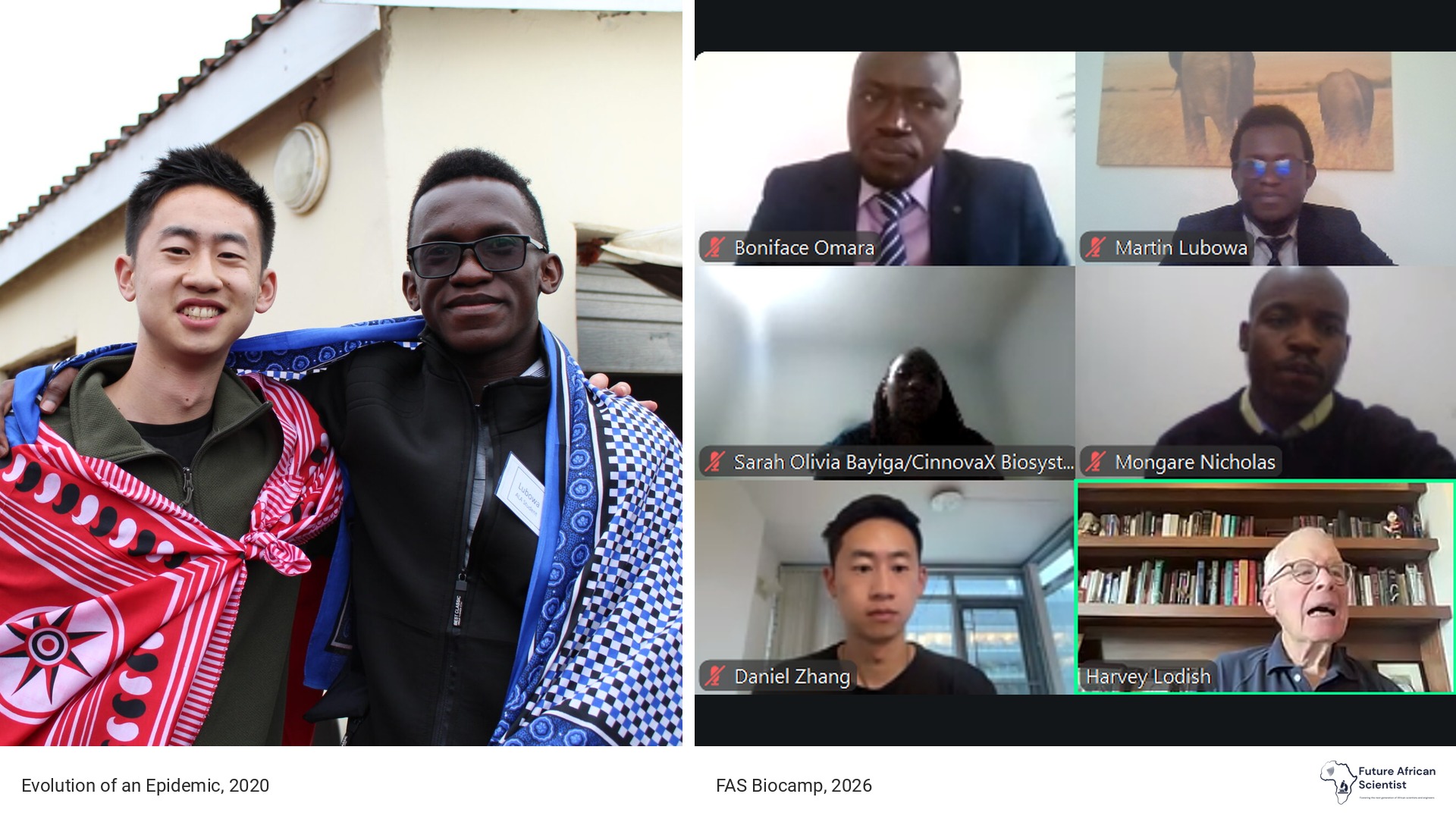
Martin Lubowa and Daniel Zhang on how Future African Scientist grew from a research bootcamp into the FAS Biocamp, a program turning Africa’s scientists into founders of real biotech companies.
Two years ago, the Ragon had the opportunity to speak with two alumni of MIT’s Evolution of an Epidemic course, Martin Lubowa and Daniel Zhang. Lubowa, an African Leadership Academy (ALA) student, and Zhang, an MIT student, met as random roommates on the course in January 2020 and formed a fast friendship built on a shared dedication to mentorship and entrepreneurship.
Together, they formed Future African Scientist (FAS), a nonprofit that turns Africa’s most driven scientists into biotech founders. Its aim is to help Africa build health and wealth sovereignty through building companies that make the continent’s own diagnostics, therapeutics and food security, and jobs for the young scientists who build them.
This year, FAS is running its first Biocamp, bringing together African scientists who are turning their own research into biotech companies. It marks a clear shift in approach from training scientists to helping them build companies.
“Our big goal when we founded Future African Scientist was for it to not be a kind of one-off program, so not us hosting these scientists for two weeks, get them very excited, and then kind of leave them off,” said Zhang. “We realized that especially in the continent of Africa, we really needed to create a roadmap.”
“The reality for most of the science graduates in Africa is they are unemployed or underemployed, so most of them are looking for an opportunity,” said Lubowa. “That means potential is actually being wasted. We’ve become more focused on merging these programs because we’re teaching people how to solve real problems, real pain points, in their communities.”
FAS began in 2021 with the African Science Research Bootcamp and grew into a four-stage pathway, from research fundamentals to a long-term opportunity network. By 2023 the team had learned that teaching science alone was not enough.
“From running our earlier programs, we saw that so many scientists wanted real opportunities they could anchor their careers around, opportunities with real economic value. They were very interested in the bioentrepreneurship side, which is why we kind of had a little bit more of a pivot,” Zhang said. “So many of them wanted to be able to found companies, to be able to work on a product, and assemble a team. So there was a really large burgeoning interest in that area.”
That interest has already begun to produce companies. In 2025, FAS ran the 12-week Bioscience Market Analysis Fellowship that sent fellows from East, West, and Central Africa to study the demand for research-grade lab consumables, the everyday supplies that African labs often pay to import. The work surfaced clear gaps in the market, and three startups grew out of it: one manufacturing DNA expression kits, one producing nuclease-free water, and one making master mixes. Some graduates of the fellowship have since joined the 2026 Biocamp as fellows and are now building companies.
One of those companies is Sol Biosciences, founded by fellowship graduate Gerald Odhiambo in Nairobi, Kenya. During the fellowship, the team surveyed scientists at research labs across Kenya, and heard the same story again and again: experiments stalled for weeks while reagents as basic as nuclease-free water cleared customs. With that industry research done, Sol Biosciences is now preparing to produce its first batches of nuclease-free and endotoxin-free molecular-grade water in Nairobi, and is mobilizing resources to roll out its first samples to labs.
The 2026 Biocamp was planned as an in-person program in Uganda, but an Ebola outbreak in the region moved it fully online. 25+ fellows from ten countries joined, each carrying a research question from their own lab, and together began building 18 ventures. During bootcamp week in June, FAS brought together Harvey Lodish, Joshua Boger and more than 16 other speakers, among them scientists, investors and commercial lawyers, who shared lessons from building and backing companies.
The cohort is structured around two themes. The first is a disease burden that global research has had little commercial reason to price: there is still no approved drug for Sudan ebolavirus, no field test for active river blindness, and no routine newborn screening for sickle cell disease across most of the continent. The second is the cost of doing science in Africa at all. Labs wait months for imported reagents and pay several times the list price for them, so a cluster of ventures is building that supply chain locally, on the bet that a research base that imports its own consumables can never set its own agenda.
Other Biocamp founders are already winning institutional backing. Biometronyx, founded by Okereke Isaac Ugbana in Enugu, Nigeria, is developing locally made clinical chemistry reagents, starting with a Total Cholesterol reagent. After industry research and interviews with hospital laboratories, Ugbana brought on two co-founders, and a Nigerian teaching hospital has signed a Letter of Intent to become Biometronyx’s first customer once its first validated batch is ready. The team is now mobilizing the resources to produce it.
Though Lubowa and Zhang have been putting in substantial work and effort since FAS’s founding in 2020, they also credit the Ragon Institute’s founding director, Dr. Bruce Walker, with helping to guide and inspire them through every stage.
“I think Bruce has really been like the central nervous system of the work we have been doing,” said Lubowa. “In terms of encouragement, in terms of giving us very wise counsel, he’s sort of how we know to move this forward. I do believe Future African Scientist would not exist if Bruce did not believe in us.”
Looking toward the future, Lubowa and Zhang plan to expand FAS further, with an in-person Biocamp in Uganda, postponed this year by the Ebola outbreak, as well as a potential dedicated space for FAS participants to grow, learn, and engage with their peers.
“I think, for the last five years we have been running Future African Scientist as a small group of people, but I think, from last year, we have been able to assemble a team of experts, experienced people who have built companies before, and since we got our 501(c)(3) status, we are moving into a phase of professionalizing the operations of Future African Scientist,” Lubowa said.
With more support, and growing interest from scientists and entrepreneurs, Lubowa sees the next phase as one built on partnership.
“One of our core goals is to really build lasting relationships, build the connections, build that financial muscle, and help in networking with the world in the West and in Africa,” said Lubowa, “in order to make sure that we have the resources to really help push Africa forward, and to build equitable partnerships with the rest of the world, for prosperity we all share.”