

 Ragon Institute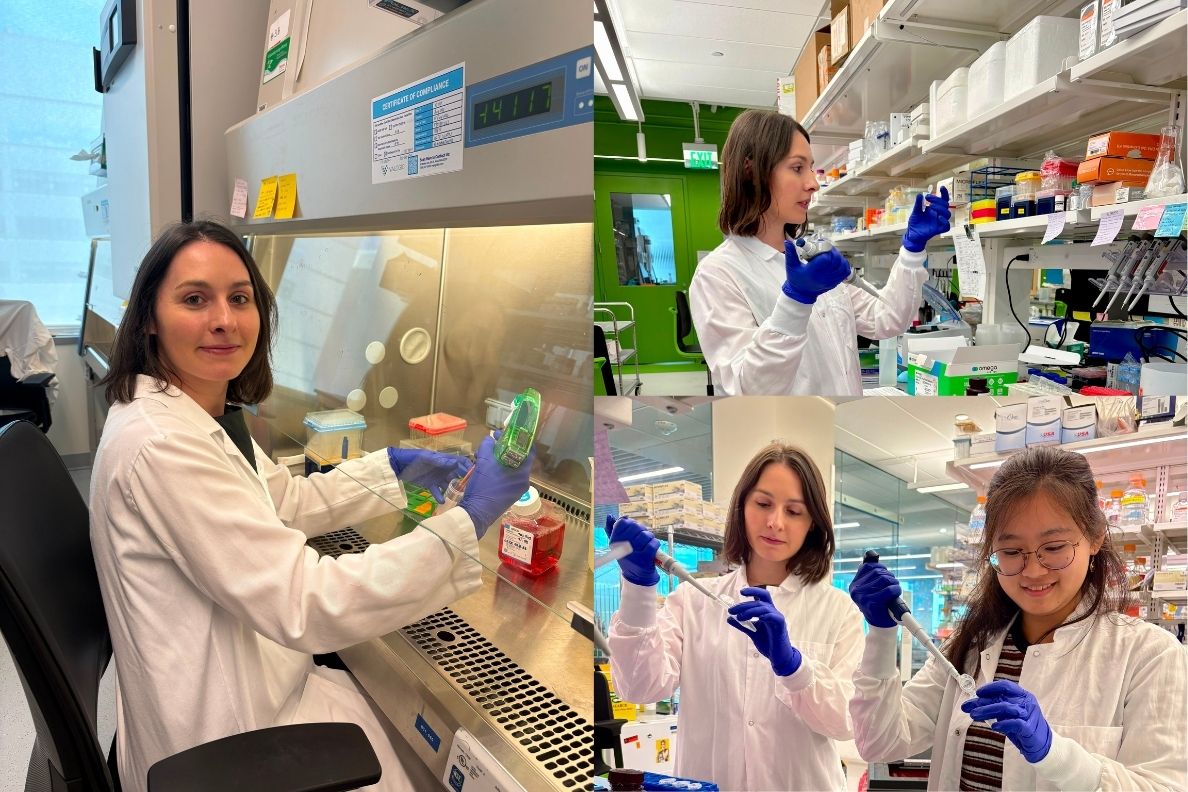
Schwab discusses her journey to the Ragon Institute and her aspirations for the future.
Exchange programs and global collaboration play a vital role in advancing scientific research, allowing researchers to share knowledge, resources and expertise across borders. It is a philosophy the Ragon Institute of Mass General Brigham, MIT, and Harvard is deeply committed to.
For Lara Schwab, PhD, the Ragon offered an opportunity to advance her research and professional growth. An exchange fellow from the Peter Doherty Institute for Infection and Immunity (Doherty Institute) in Melbourne, Australia, Schwab joined the Ragon Institute this summer for a three-month stay in the lab of Ragon faculty member Aaron Schmidt, PhD.
During her fellowship, Schwab has worked to deepen her understanding of influenza A and influenza B virus evolution, focusing on how the viruses mutate to escape the immune system and what that means for vaccine design.
We spoke with Schwab about her background, her research and her time at the Ragon Institute over the past few months.
What is your scientific background, and what were you doing before you came to the Ragon?
“I did my biomedical science undergraduate degree in Germany, and then a joint PhD between the University of Melbourne and the University of Bonn, a program called IRTG 2168. I spent the majority of my time in Melbourne, but one part of my PhD was done in Germany. In Melbourne I was working in the same department I work in now, the Department of Microbiology and Immunology, under the supervision of Patrick Reading. I worked on a new group of antiviral agents called RIG-I agonists, testing how well they work against viral infections such as influenza and respiratory syncytial virus. That gave me experience working across two different labs, and I really enjoyed having the expertise of both. It showed me the power of collaboration and how valuable it is to share knowledge.”
What is your favorite place you’ve lived, and what have you enjoyed about coming to the United States?
“My favorite city is Melbourne. I went back there for my postdoc after finishing my PhD. It is culturally diverse and open-minded, and there is a particular vibe that I really love. But I have really enjoyed Boston so far. People told me it feels very European and very American at the same time, and I think that is true.
You have the European history and everything that happened here in U.S. history, including the Declaration of Independence, which is really interesting. You also have this modern feel, with all the universities and biotech companies in Cambridge. It is an interesting combination of the modern and the historic.”
Could you describe the Doherty Institute and what it does?
“The Doherty Institute is a collaborative institute. I am employed by the University of Melbourne, but the institute is also affiliated with the Royal Melbourne Hospital, and we have a lot of collaborative services within it. There are several World Health Organization collaborating centers inside the institute, and relatively recently, in 2022, we received funding for the Cumming Global Centre for Pandemic Therapeutics, which will be housed in the new Australian Institute for Infectious Diseases (AIID).
During my PhD I was already working closely with the WHO Collaborating Centre for Reference and Research on Influenza in the Doherty Institute, because my PhD project focused on influenza viruses. Being in such close proximity was really helpful, and it still is now for my postdoc. The WHO has been generous in sharing samples with us, and that made my project so much easier. It is the close proximity, but also that everyone knows each other. It is much easier to work together, and it makes things far more efficient.”
Can you describe how you ended up here at the Ragon?
“I did my PhD at the Doherty Institute, and when I finished I was looking for jobs and knew I wanted to come back to Australia. I applied for a postdoc role in the Kent Lab, under the supervision of Stephen Kent and Marios Koutsakos. I interviewed and got the job in 2022, and I have been in that position for the last four years.
As for the Ragon, I was reading a preprint from Aaron Schmidt and Daniel Maurer about deep mutational scanning, a technique they had applied to influenza A viruses. I work on influenza B viruses, but the technique can be applied across different viruses, so I thought it might be really interesting to apply something similar to my own research. I found the data really interesting, and then I found out that Aaron Schmidt works at the Ragon Institute.
Around the same time I read in our weekly internal newsletter, Monday Minutes, about the Ragon-Doherty Fellowship and that applications are open to early- to mid-career postdocs.
I looked into it and thought that if we could build a project around applying deep mutational scanning to influenza B, it would be a really good fit.
I got in contact with Aaron to see if he was interested in taking me on for a few months. He was very positive and agreed. I prepared the application in early 2025. It took a long time to get approved, which happened in early 2026, and then I had another few months to organize the visa. Getting the visa in Australia was troublesome because of limited appointments at the U.S. consulate in Melbourne. Because I am German, I had the option to apply through a consulate in Australia or in Germany, and the waiting times in Germany were much shorter. So I ended up travelling to Germany and finally got my visa approved in Munich.”
What is the research you are conducting at the Ragon?
“Influenza A and influenza B are antigenically different. They are different types of virus, so every vaccine we receive has an influenza A component and an influenza B component. Influenza A is the virus that causes pandemics, and that is why the research focus is primarily on influenza A. Flu A can cause pandemics because it circulates in humans as well as in animals, primarily birds, which makes it easy for the virus to transmit across countries and also allows the virus to spill across species. Influenza B does not have an established animal reservoir, aside from some very minor exceptions. It primarily circulates in humans, and because it does not have this pandemic potential, research is focused less on Flu B. But in terms of disease severity, influenza B is comparable to influenza A. Depending on the season, Flu B can lead to really high mortality and morbidity rates, especially among children. That is why we think people should study influenza B more and not focus only on influenza A.
My project in Melbourne is primarily based on influenza B evolution. Every virus has surface proteins, and we look at the major surface protein of influenza, which is called hemagglutinin, or HA. Circulating viruses are constantly under pressure to introduce mutations in their HA, because this helps them evade the human immune system. At the same time, the virus has to keep the function of the protein intact, because if it mutates in the wrong way the virus will not survive.
In Melbourne we have access to more than 250 of these viruses, collected over 81 years. We did this together with the WHO. Again, that’s the power of collaboration. We looked at which mutations appeared over time and how the antigenicity of these viruses changed. We have now generated what are called antigenic maps, so we can trace back and say that a certain mutation leads to a certain antigenic change in the virus. To confirm the effect of these mutations, we can introduce them into viruses that we generate in the lab, using techniques such as reverse genetics or site-directed mutagenesis. This allows you to grow viruses from plasmids and you can study single point mutations. It is a great technique, but it is really work-intensive, because you introduce the mutations one by one. It is a slow and tedious process.
The paper Aaron published with Daniel Maurer used a technique called deep mutational scanning. Deep mutational scanning also introduces mutations in the HA, but instead of introducing them one at a time, it introduces all the different amino acid mutations in your protein of interest at once. We can generate what we call a library of viruses, which means it generates viruses carrying all possible amino acid mutations at all possible positions in the protein at the same time. These libraries are incredibly powerful for scanning which mutants escape antibody recognition and which do not. Understanding how mutants escape antibodies and immune detection will ultimately help us improve vaccine design. Aaron and Daniel generated these libraries for influenza A viruses, and my goal here at the Ragon is to learn this technique and apply it to influenza B viruses.”
What is next after you leave the Ragon?
“I would like to generate equivalent libraries for influenza B when I am back in Melbourne, and share all the knowledge I gained here with my colleagues there who might be interested in learning this kind of technique. Deep mutational scanning holds a lot of potential, not just for influenza but more broadly,and I am quite excited thinking about how I could integrate it to my own projects.”