

 Ragon Institute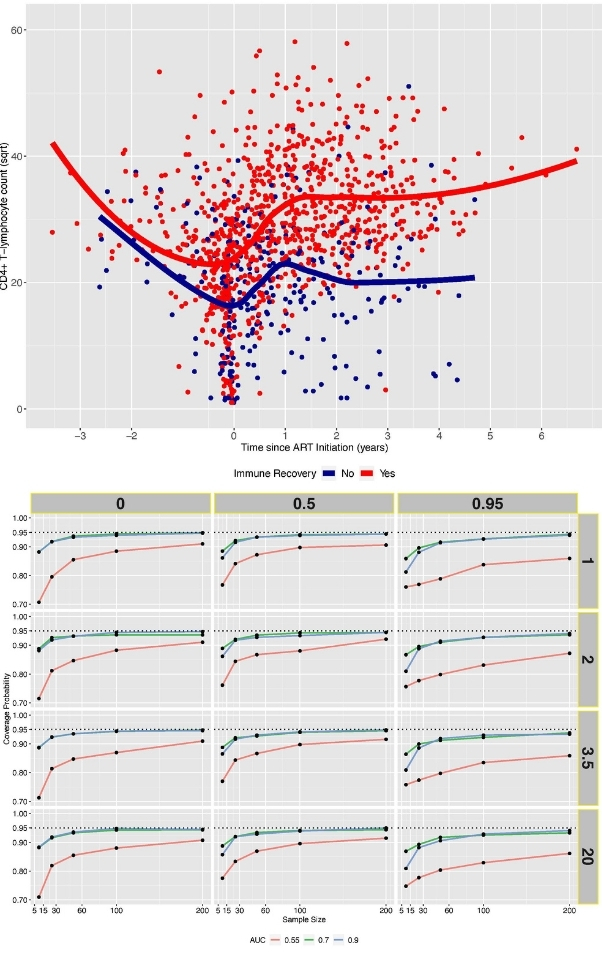
A new study from the Ghebremichael Lab at the Ragon Institute, published in the Journal of Applied Statistics, introduces a statistical framework that enables researchers to properly evaluate the diagnostic performance of biomarkers measured repeatedly over time.
Receiver operating characteristic (ROC) curves are a standard tool for assessing how well a biomarker distinguishes between patient groups. However, ROC methods were originally developed for cross-sectional data—single measurements taken at one point in time. In long-term clinical studies, biomarkers are often measured repeatedly, and existing approaches frequently assume these measurements are independent or fail to account for how patient characteristics influence classification accuracy.
The new framework addresses these limitations by incorporating both the longitudinal structure of repeated measurements and the effects of covariates on biomarker performance. Using a constant-shape bi-Weibull model, the approach estimates ROC curves and the area under the curve (AUC) while accommodating the symmetric and skewed data distributions commonly encountered in medical research. Simulation studies confirmed that the method performs well across varying sample sizes, correlation structures, and distributional assumptions.
To illustrate the framework, the team applied it to longitudinal CD4+ T cell measurements from HIV-infected children receiving antiretroviral therapy, assessing immune recovery over time and evaluating whether tuberculosis co-infection influences biomarker performance. While this application demonstrates the method’s utility in infectious disease research, the framework is broadly applicable to any longitudinal biomarker study.
The work highlights the importance of using statistical methods that properly account for the repeated-measures structure of longitudinal data, offering researchers a rigorous new tool for diagnostic assessment in long-term clinical studies.